To Top
and help us support the IOM in the fight against modern day slavery. Last day today!!!! We need to raise $8000 or all of the money raised will be returned! Check out the preview below. More Archcomix news below the fold.
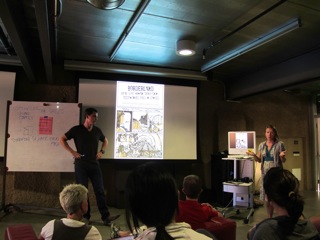 Thanks to all of those who came to see Olga and I speak at Stanford’s d.school on Thursday evening. About 40 people showed up to hear about how the project came together and discuss the challenges and obstacles creatives face in using their work to instigate social change. Journalist Cynthia Haven did a great piece about the event for Stanford, which you can read here. You’ll also notice that our fundraising tally is up – we’re at 76%, with less than 24 hours to go! Please RT and share the link to our Kickstarter page on digg, facebook, wherever – if you didn’t already know, Kickstarter will return all funds collected so far if we don’t make it to our $8000 goal by this time tomorrow.
Last week was also my first full week of classes at Stanford, which was simultaneously challenging, exhausting, exhilarating and fascinating. Running around to find my classrooms/lecture halls on the first day was surreal, but a week later I consider myself a veteran, though I’m still wrestling with some of the e-classroom/syllabi that we’re expected to attend or sign up for online. I consider it slightly ironic that my data visualization assignment took me almost as long to post to the course wiki as it did to complete. Teething troubles aside, I’ve really enjoyed throwing myself into new projects and classes that are clearly outside of my comfort zone: Human-Computer Interaction; Data Visualization; Beginner’s German; and Multimedia Production are my main courses this semester. Needless to say, good ol’ introduction to cognitive neuroscience didn’t even get a look in past week one – too many lectures to get to as it is! The project’s also coming along well, especially with the news that the Knight News Challenge is definitely on this year, so expect more about that in the next few weeks as I put my application together.
Welcome to Archcomix – if you’re new here, take a look around by clicking on the tabs above. Some have drop-down menus for individual stories under that theme. See what I’m working on at the moment as part of my John S.Knight Fellowship here and please support my Borderland comic through Kickstarter here – less than a week left to raise our money or it all gets returned. And we wouldn’t want that. Also, check out the new comics journalism page I’ve set up.
Is half of today’s choice quote, courtesy of Herb Simon: “a wealth of information creates a poverty of attention”. At least the first part is true from my first two days at Stanford, which have seen me speaking deutsch (alle ist guht), finding our natural blindspots in a neuroscience lecture (where all the retinal nerves feed back to the brain), designing an app for people waiting in line (or queuing as we say in the old world) and hearing about Edward Tufte in a data visualization lecture. Am thinking I’ve got to jettison the neuroscience in order to find some time to juggle new classes and work on this project. Speaking of which, find out about the very exciting developments with that on the project page.
In other news, the Playboy feature on the Stanford Graphic Novel is out, and the SF Chronicle have already been in touch to get Adam and my studied responses to appearing in its hallowed pages. Also gearing up for the big Borderland talk at Stanford’s d.School on Thursday at 5pm: Comics and Social Change. More on Borderland here and here – we’re almost at 50% of our total! We have it on good authority that most of the fund raising activity happens either in the opening or closing days of a pledge campaign, so please help us out if you haven’t already. We’ve had loads of RSVPs so are looking forward to a big crowd of socially-motivated graphic artists, writers and comicsphiles amongst others.

Image taken from Cagle.com
At last I’ve come up long enough for air to be able to post the notes from my interview with Daryl Cagle earlier on in the week, as promised. Daryl is MSNBC.com’s chief editorial cartoonist – click here for a vast catalogue of editorial cartoons about anything and everything topical, which is aggregated and licensed out to hundreds of different papers and websites around the world.
While to many, what Daryl and I do (single panel editorial cartoons vs. multiple-page journalistic comics) seem to be very closely related, I was surprised at how differently we approach our respective forms. It reminded me of friends and family members who interchange “animation, cartoon, comic, illustration and graphic novel writing” when asking me how my work’s going. The most obvious example of this was Daryl’s confession that:
“I don’t think our role is to inform – we hit people with our opinion…I don’t consider it my role to teach”.
Which was very interesting for me, as I consider the educational value of my work to be one of its most important aspects: how can we combine artistic and journalistic practices to create a more accessible, didactic -not to mention engaging- experience for the apathetic/inundated reader? Daryl went on to say that an editorial cartoonist’s role was “to make graphics that stand apart” from the rest of the text on the op ed page. But isn’t that selling the power of art form short? One of the fiercest contrasts with the UK in the US political forum is the vitriol that’s so liberally (no pun intended) showered on each and every polemic by the ever-burgeoning number of celebrity pundits. Combine that with the incessant torrent of the 24-hour news cycle and the average newsreader ends up being force-fed opinion without being given the opportunity to familiarize themselves with a topic. Not that the art doesn’t look fantastic and stir a great deal of lively debate – I remember my editorial cartooning days from Uni and was proud to be a Times Young Cartoonist runner-up some years back for a cartoon that featured Blair and Brown on X-factor reality show. But much like X-factor, a lot of the editorial cartoons that I’ve seen feel more like graphic gimmicks – a sort of knowing wink that at best raises a chuckle and at worst reads like a expository diagram delivered by a smug stand-up comedian convinced of his own mirthsome genius. Matt Bors, who treads the line between multi-panel comics and single panel editorial cartoons (a la Lloyd Dangle, Tom Tomorrow et al) skewers the worst offenders over at his blog if you want examples.
Still, a lot of the work Daryl’s doing as an ambassador for the form (not to mention the US State Dept) is heartening, and the global prominence of the form is something that he thinks will sustain well into the future, even if its practitioners have to be flexible to make it work financially: Daryl admitted that roughly only 75 editorial cartoonists make a living, and that “all income is from print clients”. How? By producing work with the highest resale value: cartoons on global issues, that don’t take up a lot of space, with few words. Is that really what “art for the masses” should be about?
That was the title of last night’s talk at The Hub, San Francisco featured Jack Dorsey, co-founder of Twitter, in conversation with David Batstone, President of Not for Sale as led by Michael Kieschnick, CEO of CREDO Mobile and Urban Studies Prof at Stanford. I’ll edit my video of the talk and put it on youtube later today. For the time-pressed amongst you, the highlights are below.
Olga and I cornered Jack and David at the end to tell them about our trafficking comic, Borderland (two weeks left until our Kickstarter time limit expires – order your comic now, plug plug!), as well as to discuss the opportunities for incorporating more storytelling into social media as a way of packaging the seemingly endless torrent of tweets, posts etc. Dorsey steered me towards Posterous as a way of embedding visuals in tweets – any Posterous users out there who use it to sync their WP, twit, Fb accounts?
“The power of twitter isn’t the number of people following you, it’s the potential of the universe in just one tweet” (JD)
Products in Development:
Social Media Collaborations that came up:
Thanks to the Hub for putting on a great event.
Part 3 from my latest comic, which takes 7 testimonies from victims of human trafficking and turns them into comics format. Please support the comic and anti-human trafficking measures by pre-ordering your comic from Kickstarter, the crowdsourcing site, here!
For information on the development of my Knight Journalism Project at Stanford, visit the Knight Project page here.
More news and updates below the fold, so scroll down or explore the tabs above for more comics.
 This week has been crazy with the Knight Fellowship shifting into gear and sorting out my battle plan for courses: multimedia, digital video, human rights journalism and a possible intro to neuroscience.
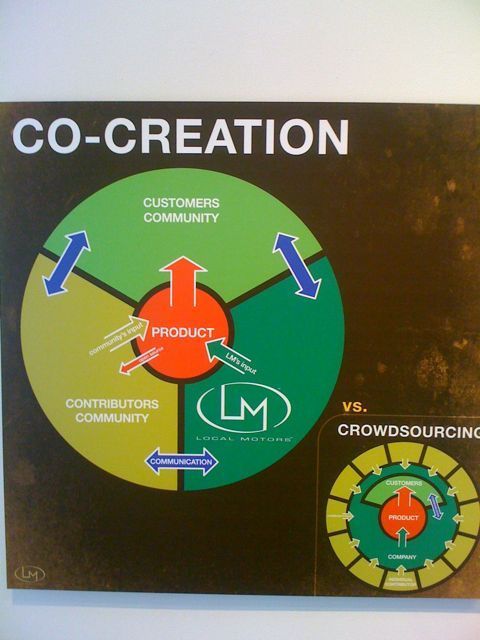
Yesterday’s field trip to the city was great for the chance to visit the Yerba Buena Center for the first time, where we checked out the TechnoCraft Exhibition – a nod in the right direction towards all things crowdsourced, collaborative, hacked, modified and prototyped. Some of the products included: the design your own Puma shoe (in a bizarre partnership with Mongolian BBQ); hacked chairs made from assorted chair entrails scattered throughout London; and a company that allows you to custom-build your own fibreglass car (using the model to the left). Inspiring, but the price tag on all of the above was a bitter reminder of the niche elite urbanite target market for all this supposedly rethought design. Even if it is made out of a freight lorry’s tarpaulin cover.
I’ve been meaning to post this link on the two-fold face of digital activism, which, according to Gaurav Mishra of Gauravonomics is either:
1. you work with a disadvantaged group that suffers from limited access to even the most basic information and tools for self-expression. or 2. you work with a group that is anything but disadvantaged. This group is at ease with using always on internet and mobile devices, both for instantaneous access to information and for self-expression and social interaction. Here, the digital activist isn’t trying to solve a crisis of capability, but a crisis of caring.”
Needless to say, my Knight project is focused on the latter, bedecked as they might be in their custom-built Pumas.
a whiteboarded rainbow of inspiration
For an update on my ever-evolving Knight Project on an online multimedia comics interface, you’ll be wanting the Knight Project page.
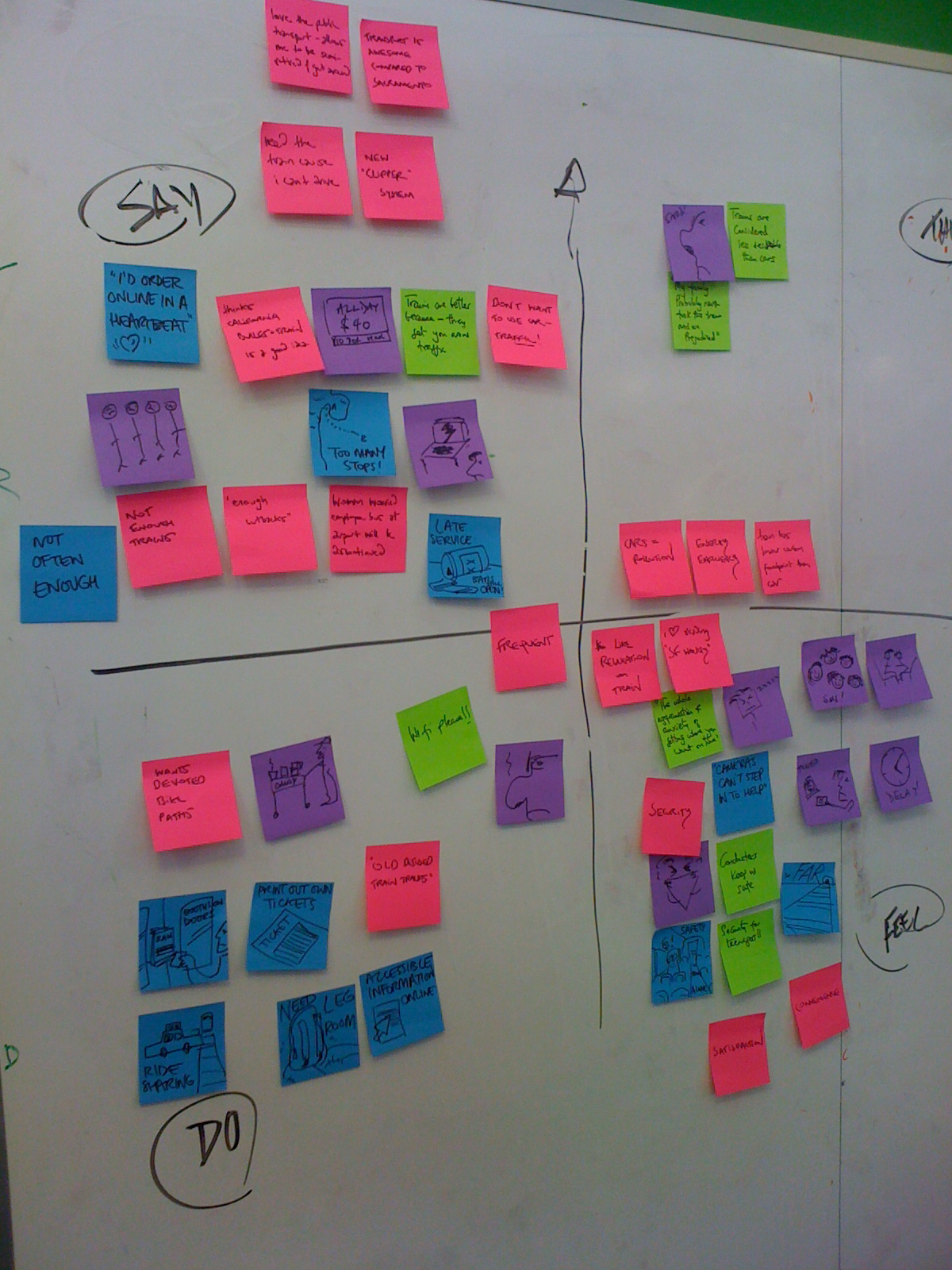
Today was the first half of the Knight’s crash-course at the Stanford D.School in design thinking, half of which took place on the Cal Train and involved tackling the challenge of commuting: how to improve the overall experience, how that varied for the different types of commuter, the emotional influencers that dictate commuters’ behaviours etc. Once we’d acosted various travellers on the Bayshore-Palo Alto slow train and dodged the wrath of the design-challenged ticket inspector, we headed back to campus to thrash out our findings with post-its and whiteboards, dividing the feedback we’d received from interviews into 4 areas: things the passengers said, things they wish Cal train would do, things they felt towards their commuting experience, and things they thought. It was all about fast iterations, prototyping and not being hung up on getting a perfect result the first time round. In fact, being too eager to find an early solution stifles the creative process and will only limit your findings. Counter-intuitive, but very rewarding and looking forward to the follow-up session when we’ll dive deeper into designing a solution for our commuters tomorrow.
If you have any suggestions or feedback on ways to improve your commute, post a comment!
Part 2 of another comic from the upcoming human trafficking comic, Borderland. Featuring 7 true stories told by human trafficking victims in comics format. Now at 1/3 of our goal! Please order your comic via Kickstarter here – $5 for a digital version, $10 for a hard copy, as well as more luxurious options like signed posters, behind the scenes views of the project’s artwork, and the chance to sponsor a copy for a Ukrainian school or NGO. More news on yesterday’s SF Zine fest journalism panel below.